

VELA LUKA CELEBRATES 50 YEARS!
On April 18, 2026, over 70 artists performed in celebration of Vela Luka Croatian Dance Ensemble’s 50 years.The idea for the ensemble was born out of Maria Franulović Petrish’s experience when she made her first return to her hometown of Vela Luka, on the island of Korčula, Croatia, in 1972. There she saw dances she had never seen, experienced klapa singing, and heard instruments she hadn’t heard before. Having left Vela Luka in 1944, at the age of 5, she’d had only glimpses of the folk culture of the homeland.
WWII had drastically disrupted life in Vela Luka and in 1944 the Franulović children and their mother had to escape. They suffered a long and arduous journey as refugees. While in the camps in Italy, their brother Paval tragically died, after which their father finally left the army and joined them, and their sister Ljubica (Binki) was born. Also at the camp, Maria was taught a bit of ballet by a Russian ballet teacher and learned her first kolo, “seljančica” (village girl). Maria and her younger sister Alma even performed for the USO.
The first time the family finally made it to the United States they were detained at Ellis Island and then turned away. Returning home was not an option, and their next move was to Haiti. Six months later they moved on to Venezuela. Yet another country, culture and language. In 1949, after five years of near constant change, they were admitted in New York and travelled by train to Anacortes, Washington, joining earlier Croatian immigrants primarily from the town of Vela Luka. The established Croatians spoke a different dialect, sang different songs, so much was different. But they had a new home, new friends, and family.
By the 1970’s, the Croatian community was thriving in Anacortes. They worked hard, primarily in the fishing industry. When the Croatian ladies came together to bake, cook, or shuck string beans, they sang. The Anacortes American Croatian Club was formed, and they gathered for dinners and dancing, enjoying music and friendship.
What Maria experienced in Vela Luka during that first trip inspired her. Her enthusiasm led her to contact Marija Šebetic, a folklorist in Vela Luka. In 1974, Marija Šebetic came all the way to Anacortes to teach several dances from Vela Luka, bringing along an old, tattered dress for Alma Franulović Plancich, the middle sister, to copy. The enthusiastic members rehearsed, costumes were sewn, and the Tanac dancers proudly performed at the ACCA Dalmatian Night Banquet and Dance to a recording of Maria’s great uncle Jure Marinović playing the accordion.
The club had a wonderful thing going with their gatherings, yet Maria wanted more. She wanted to learn more Croatian folk dances and music, and she wanted to share it, not only with Croatians, but with the general community. And wanted the entire Croatian village to participate, a multi-generational ensemble. And that is how the Vela Luka Croatian Dance Ensemble (VLCDE) was born.
Local Croatians and non-Croatians along with their children joined. The only requirement was that one respect the Croatian culture and show up and rehearse. They all had the desire, but only knew the few dances from Vela Luka. It was Sara de Luis, a distinguished flamenco dancer, who suggested that Maria reach out to Mark Morris, an incredibly talented young dancer. He was just 18 years old when he came to Anacortes and taught Croatian dances he had learned with Koleda Folk Ensemble, which had recently disbanded. He began with a few kolos, which were very different from the partner dances of Vela Luka. Mark soon departed to a new adventure in New York (dancing, choregraphing, and later establishing the Mark Morris Dance Group amongst many other accomplishments), but not before asking his friend Rick Horne, another Koleda member, to continue in his place teaching the ensemble.
Rick was encouraged by Maria’s enthusiasm and forged along with her. He set a precedent for professionalism. He brought in other past Koleda members to teach dance, choreograph, and play music, with Mary Sherhart and Jill Johnson teaching voice. They first gathered musicians from Vancouver BC for performances. Soon they gathered local Puget Sound American folk musicians who learned the music by ear and with sheet music and became the Vela Luka band. Binki Franulović Spahi, the youngest of the three sisters, was a professional vocalist who trained in opera and also sang American folk. Binki and Alma sang with the Ružice folk choir (named pragmatically by Maria because she said the group of female singers looked like a bouquet of roses – ružice). After several years with Ružice and copious performances with Radost Folk Ensemble (Radost celebrated 50 years in June 2026) and VLCDE, Alma and Binki formed the Ruže Dalmatinke Orchestra in the early 80’s, comprised of the two sisters and eight musicians, Croatians and non-Croatian superb folk musicians. Currently Bonaca (calm seas), a nine-member folk orchestra formed in 2009, directed by Pasko Kesovija who immigrated to the US from Croatia in 1993, plays for VLCDE and on their own. Ruže Dalmatinke performs with Bonaca and is now comprised of three generations: Alma, her daughter Maria Plancich Kesovija, and Marija Mila Kesovija, the daughter of Maria and Pasko.
Maria Petrish’s sons were blessed with natural talent, and have made important artistic contributions to the ensemble. Michael Petrish studied at LADO Croatian National Dance Ensemble, 1987-1988, bringing back two choreographies with him, Vrličko kolo and Baranja suite, which he later set on the ensemble. Nicholas Petrish III has shown extraordinary dedication to everything Linđo, from making the three-stringed instrument called the lijerica, mastering his playing skills and teaching others to construct and play the instrument, to returning to the town of Doli and bringing a lijerica to them when theirs (and costumes) had been destroyed in early 1990’s war in Croatia. In 2003, Nick gave the ensemble a new poskočica (Linđo) choreography, showcasing the dance style of the town of Doli. Lindjo continues as one of the most recognized choreographies, with dancer-musician John Lovrić having also mastered the lijerica. Maria Kesovija also had the good fortune to study at LADO in 1991, 1992, and 1993 and was invited to become a member, but chose to stay with VLCDE and has served as the ensemble’s Artistic Director since 1999.
The ensemble has been blessed with talented and dedicated members, directors and choreographers over the past 50 years. Every participant has been important to the success and longevity of VLCDE. It has always been a challenging yet joyful experience, years with few performers and years with a plethora of performers. Today the ensemble has over 14 choreographies from all over Croatia, with 3 American choreographies for touring in Croatia, and thousands of costume pieces, including costumes from Slavonija yet to be put on stage!.
The ensemble has performed at hundreds of festivals, events, and venues, locally (throughout Washington), nationally (Idaho, New York, Utah, Washington DC, and throughout California), and internationally (Bosnia-Herzegovina, Canada, Croatia, Mexico), and has been featured in two national television documentaries (Hrvati! (PBS, 1981) and Children of Ellis Island (ABC, 1986)) and numerous local radio and television programs, as well as books and audio recordings. In 1993, VLCDE produced a compact disc directed by Mary Sherhart. It lives on as a snapshot of the history of the ensemble, featuring songs gathered over the years.
Maria Petrish had the vision and saw it through. She has conserved the costumes, washed and ironed the whites, fed us all, put up with all our antics, taught us about the hard life and shared her drive and love for her (our) folk traditions for over 50 years. We will carry on Maria’s vision – her dream.
Article by Maria Plancich Kesovija, VLCDE Artistic Director
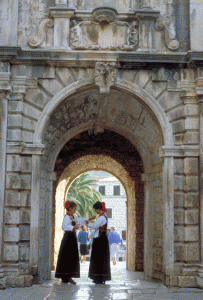 The Vela Luka Croatian Dance Ensemble, founded in 1975, perform music and dance of Croatia and the United States. Anacortes, home of the Vela Luka Croatian Dance Ensemble, is located on Fidalgo Island in the Northwest corner of Washington State. One-quarter of the residents of this unique community are descended from immigrants from another fishing village: Vela Luka, on the Island of Korčula, Croatia. The performers in Vela Luka represent four generations of Croatian Americans who have introduced their culture’s extraordinary choreography, music, and instruments to people all over the world. Forming a cross-cultural link between the Puget Sound region and Croatia, the company strives to preserve Croatian folkways and culture for generations to come.
The Ruže Dalmatinke Orchestra, a Seattle-based, professional ensemble, specializes in the music of Croatia and Bosnia. The group was founded by two sisters, Binki Franulović Spahi and Alma Franulović Plancich, who immigrated with their family to the United States after World War II from their native town of Vela Luka on the island of Korčula, Dalmatia in Croatia. BONACA, “calm seas”, formed in 2009, performs music of Croatia, the Balkans and beyond, are expert musicians who are soloists in their own right. The ensemble of talented musicians in BONACA play for Vela Luka and Ruže Dalmatinke.
Vela Luka and Ruže Dalmatinke have been featured in two national TV documentaries – Hrvati! (PBS, 1981) and Children of Ellis Island (ABC, 1986)-numerous local radio and television programs, as well as books and audio recordings. In 1986, they represented the State of Washington at the Rededication of the Statue of Liberty in New York and at EXPO ’86 in Vancouver, B.C. RD, in 1986, travelled to Mazatlán, Mexico, performing in numerous concerts. In 1988 and 1990, both groups toured Croatia and Bosnia-Hercegovina and in 2000, VL and RD traveled to the homeland once again performing throughout Croatia. They were featured performers at the Washington State Centennial Celebration in 1989; Voices West, Salt Lake City, 1991, 1993, and 1994, and the opening celebration of the Seattle Symphony’s Benaroya Hall in 1998. In 1996, the ensemble received the Governor’s Heritage Award from the Washington State Art’s Commission. Between 1996 and 2000, the ensembles performed in Idaho, Sacramento, San Francisco, and in 1999 were the featured performers at the Redlands Bowl, Redlands, California. The ensembles were featured in the King County Arts Commission Touring Arts Roster for 2002-2003 and 2009-2010. Fall 2002, VL participated in Green Meadows Productions’ Festival of Cultures west coast tour – 48 performances, 7 cities, across 3 states. The 2003 calendar included the opening of McCaw Hall, local theatre and festival performances and a February concert in San Francisco, CA. In 2004, amongst numerous local performances, VL performed at Paramount Theatre, Seattle, as part of the “DANCE this…” and the ensembles together performed for the opening of the McIntyre Hall, Mt. Vernon, WA. The 2005 calendar featured a tour to Oregon and inclusion in the Kirkland Performance Center Season. In 2008 VL performed the 10th Anniversary of DANCE this… at the Paramount Theatre, Seattle. Annual performances continued 2005-2012: Blessing of the Fleet, Gig Harbor; NW Folklife Festival; Cultural Crossroads, EHC’s Winter Worldfest and CroatiaFest. VL & RD instructors and members, over the years, have taught at local schools as part of curriculum and as special event speakers/instructors. July 2012 Ruže Dalmatinke was honored with an invitation to perform at the Library of Congress and the Kennedy Center – Millennium Stage, where introductions were made by United States Representative from Washington State, Congressman Jim McDermott, and a welcome by the Ambassador of the Republic of Croatia to the United States of America Joško Paro.
Photo by Milena Soree